
Anton
Chuvakin
CYBERSYMPOSIUMS
&
























Leena Joshi
Founder | CEO | Advisor
Crogl

John Rubey
Managing Director
Accenture

Dave Gold
VP Solutions Engineering & Americas Field CTO
SentinelOne

Yasir K
Founder & CEO
StrikeReady

Nik Seetharaman
CEO
Wraithwatch

Darwin Salazar
Head of Growth
Monad

Andrew Braunberg
Industry Analyst
Omdia

Danny Zendejas
Security Engineer

Ambuj Kumar
Co-founder and CEO
Simbian

Andrew Braunberg
Industry Analyst
Omdia
Greg Rogers
CISO, Board Member, and Advisor
Multiple Organizations

Ron Williams
Founder & CEO
Kindo (Usable Machines)

Dean Sapp
Chief Information Security Officer
Filevine

Timothy Amerson
Founder/CEO/CISO
CASMO Consulting, LLC
Mark Kraynak
Founding Partner
Acrew Capital

Jon Shende
Global Vice President SecOps (Google), TVM, IR
Sutherland

Monzy Merza
Co-Founder & CEO
Crogl

Peter Ruta
CEO & Founder
Arcanna.ai

Tom Findling
CEO
Conifers.ai

Todd Wade
Interim Chief Information Security Officer
Private Equity firm

Balázs Scheidler
CEO
Axoflow

James Morrison
Director of Security Operations Center
One Source

Mackenzie Kyle
VP of Product
Anvilogic

Steve Eyre
Security Operations Center Advisor
Cyber3D

Robert Boyce
Senior Managing Director
Accenture

Kyle Mackenzie
VP of Product
Anvilogic
Chris Abella
Pr. Sales Engineer
Dropzone AI

Balázs Scheidler
CEO
Axoflow
Learn how AI automation can amplify SecOps teams—automating repetitive triage, accelerating hunts, and improving telemetry and detection tuning—while keeping humans in control. Panelists share practical advice: start small, fix data hygiene, use human‑in‑the‑loop workflows and context‑aware alert refinement, red‑team and test in production, upskill analysts, and measure ROI as capability amplification, not just headcount savings.

Dropzone’s demo highlights its innovative approach to security by autonomously investigating Tier 1 alerts, reducing the operational burden on SOC teams and increasing investigative capacity. The platform emphasizes trust-building through transparent methodologies and adaptive learning, ensuring efficient alert triage and evidence gathering without reliance on pre-set playbooks, ultimately enhancing security and compliance for organizations.

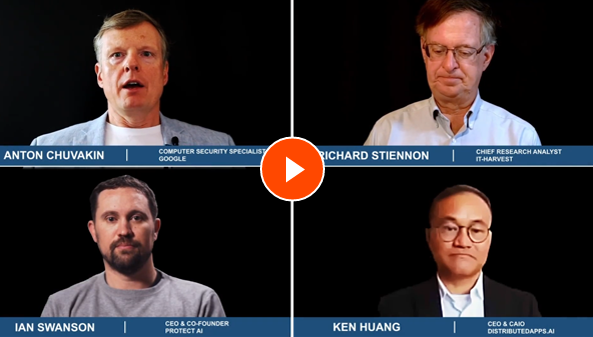
Anton Chuvakin interviews Ambuj Kumar about the transformative role of AI in the SOC in addressing the challenges of staffing and tool manage. The discussion highlights the capabilities of Symbian's AI SOC technology, which automates triage and investigation processes, thereby enhancing efficiency and accuracy while allowing human analysts to focus on more complex tasks. Key insights include the importance of contextual knowledge in threat detection and the potential for AI to significantly improve the effectiveness of Managed Security Service Providers (MSSPs) and Managed Detection and Response (MDR) services.


Richard Stiennon and Eva Abergel discuss Radware’s EPIC-AI™ and how it integrates layers of AI-powered and generative AI capabilities across Radware’s application and network protection services to secure apps, reduce mean time to resolutions (MTTR) and save costs.
Join a practical session on equipping analysts for the real world fight, covering live fire apprenticeships, principle based training over tooling, reducing alert fatigue, and using AI as a force multiplier with humans in control. Hear hiring tips (structured thinking, IT foundations, curiosity), tabletop/cyber‑range tactics, resilient incident recovery, and how to align security to business outcomes to prepare teams for evolving threats.
Dropzone’s demo highlights its innovative approach to security by autonomously investigating Tier 1 alerts, reducing the operational burden on SOC teams and increasing investigative capacity. The platform emphasizes trust-building through transparent methodologies and adaptive learning, ensuring efficient alert triage and evidence gathering without reliance on pre-set playbooks, ultimately enhancing security and compliance for organizations.
Anton Chuvakin interviews Ambuj Kumar about the transformative role of AI in the SOC in addressing the challenges of staffing and tool manage. The discussion highlights the capabilities of Symbian's AI SOC technology, which automates triage and investigation processes, thereby enhancing efficiency and accuracy while allowing human analysts to focus on more complex tasks. Key insights include the importance of contextual knowledge in threat detection and the potential for AI to significantly improve the effectiveness of Managed Security Service Providers (MSSPs) and Managed Detection and Response (MDR) services.
Richard Stiennon and Eva Abergel discuss Radware’s EPIC-AI™ and how it integrates layers of AI-powered and generative AI capabilities across Radware’s application and network protection services to secure apps, reduce mean time to resolutions (MTTR) and save costs.
Simbian
Simbian delivers the first fully autonomous security operations platform, built around purpose-trained AI agents — AI SOC Agent, AI Threat Hunt Agent, AI Pentest Agent, and AI NetSecOps Agent — that handle alert triage, investigation, and response around the clock. Every agent shares institutional knowledge through Context Lake™ and reasons on top of TrustedLLM™, Simbian's adversarial-hardened LLM layer, so automation scales without losing human judgment.

Ambuj Kumar, Co-founder and CEO of Simbian, joins Google Industry Analyst Anton Chuvakin to discuss AI SOC, alert fatigue, and tribal knowledge — and how AI agents change the shape of security operations.

A walkthrough of Simbian's AI-powered security operations platform — covering alert triage, investigation workflows, pentesting, automated response, reporting, and continuous SOC improvement.
This panel dives deep on how automation amplifies threat hunting and SOC effectiveness, covering practical workflows—from detection, triage and enrichment to hypothesis management, time boxing hunts and automation orchestration. Experts discuss staffing, training, metrics (mean time to contain, blind‑spot discovery), and reporting strategies that link hunting/automation to business value, showing how co‑pilot AI and repeatable automation turn hunting into measurable loss prevention.
Dropzone’s demo highlights its innovative approach to security by autonomously investigating Tier 1 alerts, reducing the operational burden on SOC teams and increasing investigative capacity. The platform emphasizes trust-building through transparent methodologies and adaptive learning, ensuring efficient alert triage and evidence gathering without reliance on pre-set playbooks, ultimately enhancing security and compliance for organizations.
Anton Chuvakin interviews Ambuj Kumar about the transformative role of AI in the SOC in addressing the challenges of staffing and tool manage. The discussion highlights the capabilities of Symbian's AI SOC technology, which automates triage and investigation processes, thereby enhancing efficiency and accuracy while allowing human analysts to focus on more complex tasks. Key insights include the importance of contextual knowledge in threat detection and the potential for AI to significantly improve the effectiveness of Managed Security Service Providers (MSSPs) and Managed Detection and Response (MDR) services.
Richard Stiennon and Eva Abergel discuss Radware’s EPIC-AI™ and how it integrates layers of AI-powered and generative AI capabilities across Radware’s application and network protection services to secure apps, reduce mean time to resolutions (MTTR) and save costs.
Join our panel discussion on integrating automation tools with existing security infrastructure, where experts share valuable lessons learned from their experiences. Discover the importance of initial planning, understanding the impact of automation on workflows, and the necessity of clear communication among stakeholders. Gain insights into how to effectively navigate the challenges of automation while enhancing security and operational efficiency in your organization.
Anton Chuvakin interviews Ambuj Kumar about the transformative role of AI in the SOC in addressing the challenges of staffing and tool manage. The discussion highlights the capabilities of Symbian's AI SOC technology, which automates triage and investigation processes, thereby enhancing efficiency and accuracy while allowing human analysts to focus on more complex tasks. Key insights include the importance of contextual knowledge in threat detection and the potential for AI to significantly improve the effectiveness of Managed Security Service Providers (MSSPs) and Managed Detection and Response (MDR) services.
Richard Stiennon and Eva Abergel discuss Radware’s EPIC-AI™ and how it integrates layers of AI-powered and generative AI capabilities across Radware’s application and network protection services to secure apps, reduce mean time to resolutions (MTTR) and save costs.
Dropzone’s demo highlights its innovative approach to security by autonomously investigating Tier 1 alerts, reducing the operational burden on SOC teams and increasing investigative capacity. The platform emphasizes trust-building through transparent methodologies and adaptive learning, ensuring efficient alert triage and evidence gathering without reliance on pre-set playbooks, ultimately enhancing security and compliance for organizations.
Dropzone AI
Dropzone AI is an autonomous AI SOC Analyst that investigates security alerts, mimicking the reasoning process of expert analysts. It triages alerts, correlates data, and provides decision-ready reports—helping SOC teams reduce manual investigation time and improve security response efficiency.


See how Dropzone AI acts as an autonomous Tier One analyst, investigates alerts, adapts to organizational context, learns from feedback, and builds trust through evidence.
Dropzone uses AI agents to investigate alerts, adapt to environments and expands SOC capacity to counter AI-driven threats.
An expert exploration of how AI is transforming SOCs. Gain insights from industry experts on integrating AI for better threat detection and response, overcoming cybersecurity implementation challenges, and enhancing mentorship for the next generation of analysts. Discover strategies for staying ahead in the evolving cybersecurity landscape. Don’t miss this forward-thinking conversation!


Anton Chuvakin interviews Ambuj Kumar about the transformative role of AI in the SOC in addressing the challenges of staffing and tool manage. The discussion highlights the capabilities of Symbian's AI SOC technology, which automates triage and investigation processes, thereby enhancing efficiency and accuracy while allowing human analysts to focus on more complex tasks. Key insights include the importance of contextual knowledge in threat detection and the potential for AI to significantly improve the effectiveness of Managed Security Service Providers (MSSPs) and Managed Detection and Response (MDR) services.

Dropzone’s demo highlights its innovative approach to security by autonomously investigating Tier 1 alerts, reducing the operational burden on SOC teams and increasing investigative capacity. The platform emphasizes trust-building through transparent methodologies and adaptive learning, ensuring efficient alert triage and evidence gathering without reliance on pre-set playbooks, ultimately enhancing security and compliance for organizations.

Richard Stiennon and Eva Abergel discuss Radware’s EPIC-AI™ and how it integrates layers of AI-powered and generative AI capabilities across Radware’s application and network protection services to secure apps, reduce mean time to resolutions (MTTR) and save costs.
This panel discussion delves into the integration of automation and AI into SOC workflows, emphasizing the necessity of these technologies in modern security operations. Experts share insights on best practices for implementing automation, addressing challenges such as alert fatigue and skill gaps, and highlight the potential for AI to enhance efficiency and accuracy. The conversation underscores the importance of adapting SOC strategies to leverage AI and automation effectively, paving the way for more proactive and resilient security postures.
Anton Chuvakin interviews Ambuj Kumar about the transformative role of AI in the SOC in addressing the challenges of staffing and tool manage. The discussion highlights the capabilities of Symbian's AI SOC technology, which automates triage and investigation processes, thereby enhancing efficiency and accuracy while allowing human analysts to focus on more complex tasks. Key insights include the importance of contextual knowledge in threat detection and the potential for AI to significantly improve the effectiveness of Managed Security Service Providers (MSSPs) and Managed Detection and Response (MDR) services.
Richard Stiennon and Eva Abergel discuss Radware’s EPIC-AI™ and how it integrates layers of AI-powered and generative AI capabilities across Radware’s application and network protection services to secure apps, reduce mean time to resolutions (MTTR) and save costs.
Dropzone’s demo highlights its innovative approach to security by autonomously investigating Tier 1 alerts, reducing the operational burden on SOC teams and increasing investigative capacity. The platform emphasizes trust-building through transparent methodologies and adaptive learning, ensuring efficient alert triage and evidence gathering without reliance on pre-set playbooks, ultimately enhancing security and compliance for organizations.
Exaforce
Exaforce Exabot Triage autonomously investigates security alerts across SIEM, EDR, phishing tools, and Exaforce detections, delivering context-rich verdicts in minutes. Performs Tier 1 through 3 investigations using enriched, correlated data to classify alerts as False Positive, Benign, or Needs Investigation.
An in depth conversation about how AI, automation & data quality are redefining the modern SOC featuring insights from Ankar, Co-Founder of Exaforce.

See how we ingest, normalize, enrich and store telemetry, transforming raw information into actionable intelligence.
Join industry experts as they explore the transformative role of AI in enhancing security operations. Discover how AI can streamline the detection of anomalies, minimize false positives, and ultimately empower security analysts to focus on strategic initiatives. Don’t miss this opportunity to gain valuable insights into the future of cybersecurity!
Richard Stiennon and Eva Abergel discuss Radware’s EPIC-AI™ and how it integrates layers of AI-powered and generative AI capabilities across Radware’s application and network protection services to secure apps, reduce mean time to resolutions (MTTR) and save costs.
Dropzone’s demo highlights its innovative approach to security by autonomously investigating Tier 1 alerts, reducing the operational burden on SOC teams and increasing investigative capacity. The platform emphasizes trust-building through transparent methodologies and adaptive learning, ensuring efficient alert triage and evidence gathering without reliance on pre-set playbooks, ultimately enhancing security and compliance for organizations.
Anton Chuvakin interviews Ambuj Kumar about the transformative role of AI in the SOC in addressing the challenges of staffing and tool manage. The discussion highlights the capabilities of Symbian's AI SOC technology, which automates triage and investigation processes, thereby enhancing efficiency and accuracy while allowing human analysts to focus on more complex tasks. Key insights include the importance of contextual knowledge in threat detection and the potential for AI to significantly improve the effectiveness of Managed Security Service Providers (MSSPs) and Managed Detection and Response (MDR) services.
Join our panel discussion where experts explore how automation is reshaping Security Operations Centers (SOCs). Discover the evolving roles of SOC analysts, the importance of integrating AI for efficiency, and the new skills required in an automated environment. Learn how to adapt to these changes while maintaining essential human oversight and critical thinking in cybersecurity operations. Don’t miss this insightful conversation!
Dropzone’s demo highlights its innovative approach to security by autonomously investigating Tier 1 alerts, reducing the operational burden on SOC teams and increasing investigative capacity. The platform emphasizes trust-building through transparent methodologies and adaptive learning, ensuring efficient alert triage and evidence gathering without reliance on pre-set playbooks, ultimately enhancing security and compliance for organizations.
Richard Stiennon and Eva Abergel discuss Radware’s EPIC-AI™ and how it integrates layers of AI-powered and generative AI capabilities across Radware’s application and network protection services to secure apps, reduce mean time to resolutions (MTTR) and save costs.
Anton Chuvakin interviews Ambuj Kumar about the transformative role of AI in the SOC in addressing the challenges of staffing and tool manage. The discussion highlights the capabilities of Symbian's AI SOC technology, which automates triage and investigation processes, thereby enhancing efficiency and accuracy while allowing human analysts to focus on more complex tasks. Key insights include the importance of contextual knowledge in threat detection and the potential for AI to significantly improve the effectiveness of Managed Security Service Providers (MSSPs) and Managed Detection and Response (MDR) services.
Torq
Multi-layered AI agents handle alert triage across your security stack. Hyperagents embedded in workflows process and enrich alerts in context, while a purpose-built AI SOC triage solution analyzes incoming signals from SIEM, EDR, and cloud security tools distinguishing genuine threats from noise and routing critical incidents to the right response workflows.

Leadership perspective on autonomous security operations and AI-driven threat response
Join our panel and hear indusry experts explore the transformative role of AI in security operations. Discover how to leverage automation to enhance threat detection, reduce false positives, and empower analysts to focus on strategic tasks. Stay ahead of emerging threats and learn actionable strategies to future-proof your SOC in an ever-evolving cybersecurity landscape.
Anton Chuvakin interviews Ambuj Kumar about the transformative role of AI in the SOC in addressing the challenges of staffing and tool manage. The discussion highlights the capabilities of Symbian's AI SOC technology, which automates triage and investigation processes, thereby enhancing efficiency and accuracy while allowing human analysts to focus on more complex tasks. Key insights include the importance of contextual knowledge in threat detection and the potential for AI to significantly improve the effectiveness of Managed Security Service Providers (MSSPs) and Managed Detection and Response (MDR) services.
Richard Stiennon and Eva Abergel discuss Radware’s EPIC-AI™ and how it integrates layers of AI-powered and generative AI capabilities across Radware’s application and network protection services to secure apps, reduce mean time to resolutions (MTTR) and save costs.
Dropzone’s demo highlights its innovative approach to security by autonomously investigating Tier 1 alerts, reducing the operational burden on SOC teams and increasing investigative capacity. The platform emphasizes trust-building through transparent methodologies and adaptive learning, ensuring efficient alert triage and evidence gathering without reliance on pre-set playbooks, ultimately enhancing security and compliance for organizations.
Panelists examine SOAR’s role in modern SOCs including the orchestration of workflows and automating repetitive tasks paired with AI and agentic agents for dynamic investigations. They assess hurdles such as tool sprawl, coding burden, ROI and shallow metrics, while advocating human-in-the-loop guardrails, standardized playbooks, better observability and KPIs and a shift toward predictive, self-healing operations.
Richard Stiennon and Eva Abergel discuss Radware’s EPIC-AI™ and how it integrates layers of AI-powered and generative AI capabilities across Radware’s application and network protection services to secure apps, reduce mean time to resolutions (MTTR) and save costs.
Anton Chuvakin interviews Ambuj Kumar about the transformative role of AI in the SOC in addressing the challenges of staffing and tool manage. The discussion highlights the capabilities of Symbian's AI SOC technology, which automates triage and investigation processes, thereby enhancing efficiency and accuracy while allowing human analysts to focus on more complex tasks. Key insights include the importance of contextual knowledge in threat detection and the potential for AI to significantly improve the effectiveness of Managed Security Service Providers (MSSPs) and Managed Detection and Response (MDR) services.
Dropzone’s demo highlights its innovative approach to security by autonomously investigating Tier 1 alerts, reducing the operational burden on SOC teams and increasing investigative capacity. The platform emphasizes trust-building through transparent methodologies and adaptive learning, ensuring efficient alert triage and evidence gathering without reliance on pre-set playbooks, ultimately enhancing security and compliance for organizations.
Vega
Enable your SOC to create & deploy complex detection-as-code scenarios, or access Vega’s library of read to deploy, MITRE mapped detections
Join SOC leaders tackling why SOAR pilots stall and automation fails—poor data pipelines, brittle playbooks, maintenance overhead, cultural resistance and weak governance that amplify risk instead of reducing it. Panelists share a practical roadmap—start left with ingest/normalization, treat playbooks as code with CI/CD, add gradual human‑in‑the‑loop automation and pilot AI agents—so you can scale triage safely, cut alert noise and win executive trust.
Richard Stiennon and Eva Abergel discuss Radware’s EPIC-AI™ and how it integrates layers of AI-powered and generative AI capabilities across Radware’s application and network protection services to secure apps, reduce mean time to resolutions (MTTR) and save costs.
Anton Chuvakin interviews Ambuj Kumar about the transformative role of AI in the SOC in addressing the challenges of staffing and tool manage. The discussion highlights the capabilities of Symbian's AI SOC technology, which automates triage and investigation processes, thereby enhancing efficiency and accuracy while allowing human analysts to focus on more complex tasks. Key insights include the importance of contextual knowledge in threat detection and the potential for AI to significantly improve the effectiveness of Managed Security Service Providers (MSSPs) and Managed Detection and Response (MDR) services.
Dropzone’s demo highlights its innovative approach to security by autonomously investigating Tier 1 alerts, reducing the operational burden on SOC teams and increasing investigative capacity. The platform emphasizes trust-building through transparent methodologies and adaptive learning, ensuring efficient alert triage and evidence gathering without reliance on pre-set playbooks, ultimately enhancing security and compliance for organizations.
Join SOC leaders as they unpack how machine learning and agentic AI can cut alert noise, accelerate triage and lower MTTR — while showing real deployment patterns (crawl/walk/run), trust metrics and measurable ROI. Panelists debate defensive vs. offensive AI, attacker automation, data/context integration, federation vs. single‑platform strategies, and pragmatic steps to pilot AI‑SOC safely without exploding inference costs.
Dropzone’s demo highlights its innovative approach to security by autonomously investigating Tier 1 alerts, reducing the operational burden on SOC teams and increasing investigative capacity. The platform emphasizes trust-building through transparent methodologies and adaptive learning, ensuring efficient alert triage and evidence gathering without reliance on pre-set playbooks, ultimately enhancing security and compliance for organizations.
Richard Stiennon and Eva Abergel discuss Radware’s EPIC-AI™ and how it integrates layers of AI-powered and generative AI capabilities across Radware’s application and network protection services to secure apps, reduce mean time to resolutions (MTTR) and save costs.
Anton Chuvakin interviews Ambuj Kumar about the transformative role of AI in the SOC in addressing the challenges of staffing and tool manage. The discussion highlights the capabilities of Symbian's AI SOC technology, which automates triage and investigation processes, thereby enhancing efficiency and accuracy while allowing human analysts to focus on more complex tasks. Key insights include the importance of contextual knowledge in threat detection and the potential for AI to significantly improve the effectiveness of Managed Security Service Providers (MSSPs) and Managed Detection and Response (MDR) services.
Anvilogic
Our mission is to make advanced detection accessible to every security team, enabling them to detect across hybrid, multi-cloud, and data lake environments while keeping their data where it belongs. We meet teams where they are, with a unified, AI-native approach built for flexibility, precision, and scale. Anvilogic was created by operators who've lived the challenges of brittle rules, false positives, and siloed logs.
Alex explains how Anvilogic modernizes detection by replacing legacy SIEMs with a scalable, data-centric, AI-driven solution

See how our AI SOC platform provides automated detection, lifecycle management, and other AI driven capabilities
This panel discussion examines the future of SOC automation, focusing on the role of AI in enhancing security operations. Experts highlight the importance of balancing automation with human oversight to tackle modern cyber threats effectively. The conversation provides insights into innovations that drive smarter decision-making and improve security posture.
Anton Chuvakin interviews Ambuj Kumar about the transformative role of AI in the SOC in addressing the challenges of staffing and tool manage. The discussion highlights the capabilities of Symbian's AI SOC technology, which automates triage and investigation processes, thereby enhancing efficiency and accuracy while allowing human analysts to focus on more complex tasks. Key insights include the importance of contextual knowledge in threat detection and the potential for AI to significantly improve the effectiveness of Managed Security Service Providers (MSSPs) and Managed Detection and Response (MDR) services.
Richard Stiennon and Eva Abergel discuss Radware’s EPIC-AI™ and how it integrates layers of AI-powered and generative AI capabilities across Radware’s application and network protection services to secure apps, reduce mean time to resolutions (MTTR) and save costs.
Dropzone’s demo highlights its innovative approach to security by autonomously investigating Tier 1 alerts, reducing the operational burden on SOC teams and increasing investigative capacity. The platform emphasizes trust-building through transparent methodologies and adaptive learning, ensuring efficient alert triage and evidence gathering without reliance on pre-set playbooks, ultimately enhancing security and compliance for organizations.
Where does automation deliver the biggest payoff in incident response? This panel dives into triage, enrichment, and Tier‑1/2 playbooks—plus when to keep humans in the loop for high‑risk actions. Learn how to accelerate time‑to‑trust (~90 days), surface SOC bottlenecks, curb LLM hallucinations and strengthen governance, metrics, and skills, with pragmatic takeaways, MSSP-tested practices and defenses against AI‑enabled attacks like deepfakes.
Anton Chuvakin interviews Ambuj Kumar about the transformative role of AI in the SOC in addressing the challenges of staffing and tool manage. The discussion highlights the capabilities of Symbian's AI SOC technology, which automates triage and investigation processes, thereby enhancing efficiency and accuracy while allowing human analysts to focus on more complex tasks. Key insights include the importance of contextual knowledge in threat detection and the potential for AI to significantly improve the effectiveness of Managed Security Service Providers (MSSPs) and Managed Detection and Response (MDR) services.
Richard Stiennon and Eva Abergel discuss Radware’s EPIC-AI™ and how it integrates layers of AI-powered and generative AI capabilities across Radware’s application and network protection services to secure apps, reduce mean time to resolutions (MTTR) and save costs.
Dropzone’s demo highlights its innovative approach to security by autonomously investigating Tier 1 alerts, reducing the operational burden on SOC teams and increasing investigative capacity. The platform emphasizes trust-building through transparent methodologies and adaptive learning, ensuring efficient alert triage and evidence gathering without reliance on pre-set playbooks, ultimately enhancing security and compliance for organizations.
StrikeReady
StrikeReady’s AI powered data pipeline ingests, normalizes, enriches, and stores telemetry, transforming raw information into actionable intelligence by correlating behavioral baselines and contextual intelligence to identify and expose complex attacks.

Alex explains how StrikeReady unifies alerts, personas, and threat intel into one platform, helping SOC teams investigate faster, prioritize better, and validate detection across their entire stack.

See how we ingest, normalize, enrich and store telemetry, transforming raw information into actionable intelligence.
D3 Security
D3’s Morpheus ingests events from all sources, strips IOCs instantly and builds a contextual playbook with full stack, time based threat analysis. Our technology analyzes links, generates a full stack risk score and prioritizes based on impact—driven by deep context and intense security intelligence. Your team receives a full incident picture with summaries, timelines, key findings, and precise action steps for fast, effective remediation.

Andesite
This foundationally AI designed platform connects workstreams and data silos into the same view across security platforms and tools and get alerts from multiple sources, prioritized in the same list. No ETL required,no data migration or extraction needed, no delays. AI-driven investigations can be traced back to verified sources and insights so humans can review and replay the analysis.

Seceon
Seceon's platform utilizes AI to instantaneously collect telemetry from endpoints, firewalls, cloud apps, identity providers, and more—centralizing your threat landscape for a comprehensive view. Built-in normalization nd enrichment deliver structured, usable data for fast decisions.

Radware
Radware’s AI SOC Xpert technology continuously analyzes attack behavior across protected assets. Rather than monitoring thresholds alone, it learns from traffic evolution, recognizing when patterns shift and how protections respond. The result is a coherent incident narrative that accelerates triage, sharpens decision‑making, and significantly reduces time to resolution.


AI SOC Xpert brings the power of AI to redefine how SOCs handle security incidents. By automating and accelerating incident resolution, it significantly reduces Mean Time to Resolution (MTTR) by up to 20X.